Originally posted on LinkedIn
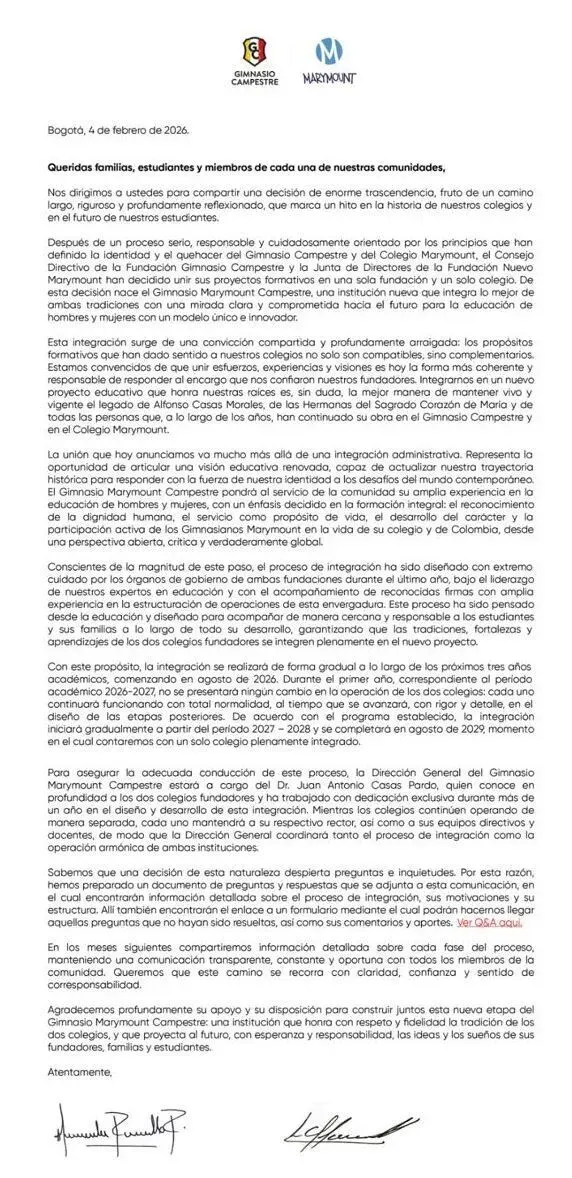
Big news in K12 education that I haven’t seen getting much attention — Colegio Marymount and Gimnasio Campestre merged 🤯
A crystal-clear effect of the cultural and social shifts of the last 20 years.
For those not from Bogotá — these schools were for a long time two of the city’s heavyweights in education. Both operating for 80 years, consistently at the top of quality rankings, pillars of the sector.
A merger like this is no small thing — to put it in perspective, each student represents roughly ~60 million COP per year in revenue, and around 1 billion COP over their entire school career. A school of this size (~2,000 students) is running a business worth hundreds of billions of pesos.
This merger is an M&A between LARGE organizations.
The problem — that base has shrunk dramatically over the last two decades.
Why:
1️⃣ Fewer kids. Birth rates have dropped from over 2 children per woman to under 1 in those 20 years. 2️⃣ Culture has moved away from single-sex and religious schools, with strong preference now for co-ed and secular schools.
Put those together — schools that used to enroll 3–4 full classrooms of 30–40 students per year (~100–200 first-graders) are now seeing 15 to 20. 15 to 20!! An 80–90% drop in admissions.
It didn’t only happen to these two — others have reacted. El Moderno switched to calendar B and went co-ed. El Cervantes went co-ed.
Others brought in new leadership and ideas to reinvent themselves. New faces, new thinking 💡 El Buckingham with Juliana Salazar Borda and the HEI program. Juan Sebastián Hoyos Montes at El Moderno. Luis Eduardo Rivas Garzón at El Richmond. Rafael Castro at Los Cerros. Camilo Bonilla Perez at El Tilatá.
Others closed entirely. El Sans Facon famously. And 60 schools a year in Bogotá close for these exact reasons.
The lesson — adapt or die. New ideas, models, and frameworks need to come to education at every level — but especially in K12.
Wishing Marymount and Campestre the best on this journey, and congratulations to Juan Antonio Casas for the road ahead and for making such a bold decision.
What do you think about this change? How else do you think schools can adapt to the new realities? Which institutions are doing it well — and which ones should be moving but aren’t?