Fault 01
Reported by the owner
What the spreadsheet says isn't what the program you bought says.
and when they disagree, whoever talks loudest in the meeting wins
without changing the whole company — one little box at a time
I build software around the way your company already works, so you don't have to bend the company to fit a program you bought.
chi·no·má·ti·co, ca
adj. · Colombian Spanish
Your own software · No monthly per-seat fee · You can change it afterwards
I've built technology for




 Finco
Finco 





 Beriblock
  El Palomo
 What the spreadsheet says isn't what the program you bought says.
and when they disagree, whoever talks loudest in the meeting wins
Someone set up a new system that nobody uses, holding data from eight months ago.
It was half filled in and nobody says so, because setting it up was hard work.
People have to enter the same thing twice, in two places.
the little boxes aren't connected, and the one who suffers is the one typing
There's no single source of truth: to find out how much you sold yesterday, you have to ask someone.
The number lives in three places and none of them match.
You were sold — for a fortune — a program that on the inside is a list, a button and an email.
It nearly always comes padded with modules your company will never open.
The process looks automatic and in fact there's someone doing it by hand, every day.
and they do it well, which is why nobody has noticed
If that person gets sick, it stops. If they quit, the process walks out with them.
And whoever comes next learns it by word of mouth.
If none of this sounds familiar, I'm probably not the right person.
Ten lines. Tick the ones you recognise in your company.
It's an estimate, not an audit.
Nothing measured yet
Tick the lines you recognise.
WhatsApp opens with the message ready. You can edit it before sending.
Or book forty-five minutesMarketing sends traffic to the website and to WhatsApp. That produces leads for sales. Sales feeds information back to marketing and opens up work for operations and admin. Each of those is a little box, and each box has its own system.
I build those boxes and connect them. The CRM your sales process needs, the system operations works in, admin's invoicing: I build whichever one is missing, made to fit how you already work, and I leave it connected to the rest.
Manual step Connected
Marketing
5thWhatever the channel
A campaign manager on one side and a spreadsheet on the other.
The same campaign manager. Now it actually knows which campaign brought the sale.
Website
4thThe site
A separate system, from another vendor, that emails someone.
Still your website. What comes in through it now lands where it should.
The chat
One person's phone. If that person isn't around, nobody is.
What's said in the chat is recorded without anyone transcribing it.
Sales
1stThe leads
An expensive CRM that's half used, because filling it in is double work.
The CRM I build for your sales process. Filling it in stopped being extra work.
Operations
2ndThe work
A spreadsheet only one person understands.
The operations system I build you. The work opens by itself when the sale closes.
Operations
(the other one)
Two boxes for the same work
No longer needed
The Notion someone set up, with data from eight months ago. And they have to fill in both.
The work lives in one. Whatever was worth keeping moved across before it was switched off.
Admin
3rdInvoicing and paperwork
Another spreadsheet. And the invoice is made by hand, one at a time.
The invoice comes out of the sale by itself, data already in it.
And back to marketing: today nobody feeds the data back, so marketing doesn't know which campaign brought the sale. every sale tells marketing where it came from.
There's no single source of truth
There are three versions of the same number and none of them agree. To find out which one is right, you have to ask someone.
A single source of truth
The data lives in one place. When someone asks how much was sold yesterday, everyone looks at the same number.
I build the box and leave it connected before moving to the next one.
The fake-automated part shows up in the middle: someone takes data out of one box and puts it into the next, every day. Once the connection is made, that person stops copying and pasting and goes back to serving customers, which is what you hired them for.
The red numbers are the order of a typical case. In yours, we start where it hurts most.
if two boxes are held together by a person in the middle, they're chinomáticas
I build the tool to fit your processes. The code ends up in your company's name and there's no monthly per-seat fee. Before I step off, I teach your people to change it without calling me.
What I build you
I do both the strategy and the tool. There's no consultant handing over a deck and a vendor interpreting it their own way. What we decide on Monday, I start building on Tuesday.
that's why I take on few projects
I code with AI agents instead of subcontracting, which lets me build fast.
I also teach your people to use them for the office work they do by hand today.
this changed a lot in the last two years
The usual approach is to buy something built for another company and make your people adapt. I start by looking at how the work gets done today and build on that.
That's why people actually use it.
in the first week I sit down with whoever is going to use it
I talk to the people who run it, not just to you, and I watch how it's really done.
A short plan, the bottleneck worth attacking first, and one first thing already working. If it isn't worth it to you, we stop there.
I build the tool, the CRM and the connections between boxes. It ends with your team using it.
I do it while you carry on with your business.
Field log · Responsible: Salomón
A working tool, with your data, that your people are already using.
The tool, running
With your real data, not sample data.
The code, in the company's name
The repository is in your company's name, not mine. If tomorrow you want to work with someone else, you take all of it with you.
How to change it without me
I teach you and your team to make changes with AI. You don't have to call me to move a button.
Your people trained
And a recording of the training, for whoever joins six months from now.
The accounts, the passwords and the access
All in the company's name, nothing in mine.
The process on one page, and the time measured
What ended up automatic and what stayed manual on purpose. We time the process going in and coming out, and I hand you the number.
Two reviews and my WhatsApp
At one month and at two, to adjust whatever real use calls for. And you write to me directly.
I don't change the whole company: it's one process at a time. I don't build technology teams or sell licences. And if what you need already exists and works, I'll tell you instead of building it.
one process at a time, and when that one is settled we'll talk about the second
I also don't do

Ignia Today
A new model for higher education. I built its website, the system the courses run on, the CRM and the community portal.

Finco 2019 — 2022
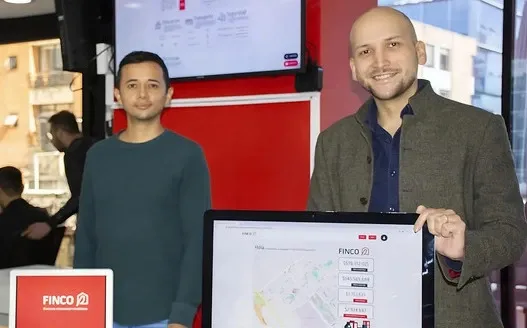
Real-estate valuation with data and AI for all of Latin America. A hundred thousand reports a year. Sold to RED Atlas.

PrestaGente 2017 — 2019
Peer-to-peer payroll lending. Sold to Taurus Capital and it still runs, without me.

Beriblock 2018 — 2019
Promissory-note authentication with blockchain. Went under. The technology worked; the market didn't exist.

El Palomo 2016 — 2017
Flowers by subscription. Failed. Happy to tell you the story.
R5 As an employee
I led around forty people. I built the entire data pipeline and the risk-modelling system.
The first one on the list is what takes up my Monday to Friday. I talk about that further down, when I explain why there are so few slots.
My father and my grandfather were business owners too.
Because this isn't my main job. Monday to Friday I build Ignia, my company, and the rest of the time goes to my four-year-old twins and running.
I'd rather have few clients and serve them well.
Updated on 6 September 2026
What the rest of the time goes to



2 of 4
consulting slots taken at once
4 at a time at most, because I'm the one building. I don't publish client names without their permission.
Take one of the two that are leftIf you're just getting started, what you want is mentoring.
If your question isn't here, write to me and I'll answer it myself.
You don't need to. Part of my job is explaining it clearly; if something isn't clear, that's on me. My clients are clothing brands, restaurants, distributors, importers and service businesses.
No. You get something running, your team trained to use it, and a short document in plain language with what we decided and why.
Almost never. First I look at what already works and why nobody opens it. Very often the program is fine, but it's disconnected from everything else, which is why filling it in is double work.
One of them, always. We look at which one people actually use, move over what's worth keeping and turn the other one off. While both exist, someone has to fill in both — and they will get it wrong.
If you're already selling and you have between five and forty people, you're exactly where I'm most useful. Where I'm not useful is once the company is big and what it needs is to scale much further.
The code is in your company's name, and before I step off I teach your people to change it with AI: how to ask for the change and how to ship it. The point is that you don't depend on me.
Monday to Friday I build Ignia, which is my company. I have four-year-old twins and I don't work Sundays. That's why I only take four consulting engagements at a time.
I'll tell you on the first call and, if I can, point you to someone who is.
Tell me what you have running and I'll tell you if I can help.
No forms
You write, I answer.
No team behind me
The person who answers and the person who builds are the same.